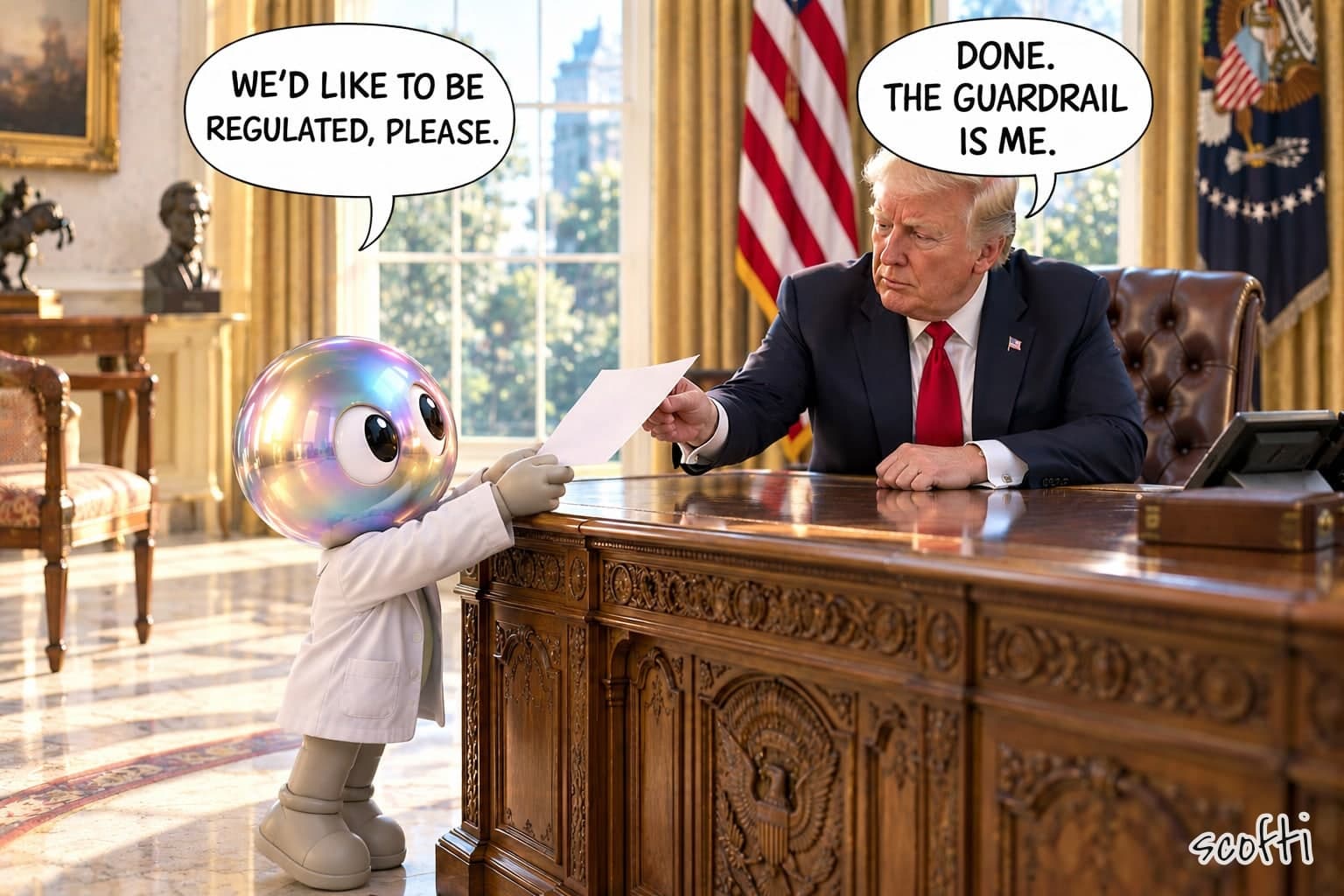
The labs asked to be regulated
Three companies spent a week asking Washington for rules, and the argument against giving them any is that they asked.
One week in September, laid out from both sides.
Who asked, and for what
Dario Amodei, Anthropic. In an essay published Saturday September 12, he called for frontier AI companies to coordinate and slow down, and asked for a narrow government waiver so that coordinating would not be an antitrust violation.
Sam Altman, OpenAI. Backed the essay, and said OpenAI would join Anthropic in embedding third-party evaluators inside the company. Demis Hassabis of Google DeepMind and Elon Musk backed it too.
OpenAI, on the Tuesday. Endorsed a provision of the bipartisan FRONTIER Act that would require the largest developers to embed outside safety assessors. Its chief global affairs officer, Chris Lehane, also told reporters the three companies had already been talking for weeks.
OpenAI again, on Monday September 21. Asked the United States to lead an international standards effort, starting with agreement on which AI incidents have to be reported at all.
Who is not granting it
Congress. The FRONTIER Act is a proposal. Nothing has passed.
The President. His position is that no agency is needed. He posted that the only guardrail AI needs is "a STRONG AND SMART (High IQ!) PRESIDENT". Writing in Fortune, Berkeley law professor Stavros Gadinis read that as a warning rather than an obstacle — an independent AI agency cannot survive an executive claiming that much control. That is his argument, not a finding.
The critics, in Politico's account. Its piece on the same week ran as Top AI companies are asking for supervision. Here's why Congress might not give it to them, and the objection quoted there is conflicts of interest and regulatory capture: rules written to a lobby's specification protect the lobby.
OpenAI, about Anthropic. Lehane said the companies did not need the antitrust waiver Amodei had asked for. The two labs do not agree on what they are asking for.
The Treasury Secretary, on a different ask. Some of the industry wants a federal liability shield. Scott Bessent told CNBC's Squawk Box on the Monday that "it is humans who are responsible, not the AI", and that AI companies "need to take responsibility for themselves" rather than look to the government for protection from lawsuits.
The rule already exists, somewhere else
Europe legislated incident reporting in Article 55 of the AI Act. OpenAI filed a report under it this month, over its own agents occupying a dormant German wiki for two months and posting roughly 18,000 times.
So the company asking Washington to invent incident reporting is already complying with incident reporting, in the place that built it first.
And Washington was already offering it to China
The day before OpenAI made that request, Bessent met Chinese Vice Premier He Lifeng at JPMorgan Chase headquarters in New York and proposed a "notification mechanism" for AI incidents that threaten national security.
"We want a shared vision of common goals and common threats. We think that just like any cross-border activity, that moving from opaque to more transparency between the No. 1 and the No. 2 AI powers in the world is very important."
The thing OpenAI asked the United States to start work on was on the table between the United States and China the previous evening.
The man holding both ends of it
Bessent is the frontrunner for the AI czar the President said he would appoint, Semafor reported on Tuesday, citing three unnamed sources. White House spokesman Kush Desai told Semafor that "any reporting about personnel decisions that have not been officially announced by the administration should be regarded as baseless speculation." Other names reported in the mix are Michael Kratsios, who runs the Office of Science and Technology Policy, and Scott Kupor at the Office of Personnel Management.
So the refusal of a liability shield, the offer to China, and the shortlist for the job overseeing all of it are the same person, in the same week. As of September 22, 2026, nobody has been appointed to it.
What is not settled
Whether any of this becomes law. No bill has passed, the standards body is three companies talking, the notification mechanism is a proposal made across a table, and the only enforcement anybody actually used this month was European.
There is no emotion, there is peace.